




CNSAC Disposable EEG Cup Electrodes – Silver/Silver Chloride (Ag/AgCl)
Summary
Eine gute EEG‑Messung beginnt immer an der Schnittstelle zwischen Elektrode und Haut. Gerade weil EEG‑Signale extrem empfindlich sind, braucht es Elektroden, die zuverlässig, stabil und reproduzierbar arbeiten. Die CNSAC Einweg‑EEG‑Cup‑Elektroden bieten genau das: Sie kombinieren bewährte Ag/AgCl‑Technologie mit einem standardisierten Einmal‑Design, das jede Untersuchung mit identischen Ausgangsbedingungen starten lässt. Das sorgt für konsistente Signalqualität, erleichtert mehrkanalige Messungen und reduziert den Aufwand für technische Kontrollen. Gleichzeitig unterstützen Einweg‑Elektroden einen hygienischen und effizienten Workflow – besonders in Schlaflaboren, neurologischen Abteilungen und überall dort, wo viele EEG‑Untersuchungen durchgeführt werden. Mit verschiedenen Kabellängen und einem klaren Fokus auf moderne klinische Anforderungen bieten die CNSAC Einweg‑EEG‑Cup‑Elektroden eine praktische, sichere und zuverlässige Lösung für die Neurodiagnostik von heute.
Consistent EEG Signal Quality and Efficient Workflows in Modern Neurodiagnostics
A reliable and consistent EEG recording places high demands on the entire measurement chain. EEG signals are in the microvolt range. Therefore, even minor changes at the electrode-skin interface can affect the quality of the recording.
Particularly in areas involving numerous tests, multichannel measurements, and long-term recordings, it is essential to ensure that electrode performance remains as consistent and reproducible as possible.
CNSAC disposable EEG cup electrodes combine established Ag/AgCl technology with a standardized single-use design, making them ideally suited to the requirements of modern neurophysiological workflows.
Why the Electrode-Skin Interface Is So Important
Electroencephalography (EEG) records electrical signals in the microvolt range. As a result, the measurement is sensitive to changes at the interface between the skin and the electrode.
Differences, for example, in:
- the properties of the electrodes,
- skin preparation,
- the impedance,
- electrode polarization,
- contact stability, or
- handling
can affect signal quality and contribute to noise, baseline shifts, or artifacts.
This is particularly relevant for multichannel and longer-duration examinations.
Standardization as a Key Factor in the EEG Workflow
Modern neurodiagnostic facilities, such as sleep labs, epilepsy monitoring units, and neurology departments, often handle a high volume of examinations and recurring measurements.
Under such conditions, standardization plays an important role.
If the characteristics of the electrodes used vary from test to test, this can result in additional work—for example, due to:
- further adjustments to the electrodes,
- additional checks,
- Interruptions in the recording or
- an increased workload for technical staff
A standardized electrode system can help reduce such variations in the daily workflow.
Ag/AgCl – a proven electrode material for EEG applications
Silver/silver chloride (Ag/AgCl) is one of the established electrode materials used for electrophysiological measurements.
- stable electrochemical behavior,
- low polarization and
- Reliable signal transmission.
This makes Ag/AgCl suitable for applications that require the most stable detection possible of weak bioelectrical signals.
The Advantage of a Standardized Single-Use Electrode System
For reusable electrodes, their condition, cleaning, reconditioning, and wear can affect the electrode's properties over time.
In contrast, single-use electrodes provide a new, standardized interface for each examination.
This allows for variations related to:
- previous use,
- Cleaning and Processing,
- Wear and tear, as well as
- different electrode states
can be avoided.
This standardization can help ensure a more reproducible and efficient workflow, particularly for EEG examinations involving multiple channels.
Hygiene and Infection Control
In addition to signal quality, infection prevention also plays an important role in the selection of electrodes for clinical use.
A single-use product is not used on another patient after it has been used. This eliminates the need to reprocess the electrode between patients.
This can be particularly true in facilities with:
- a high volume of examinations,
- Sleep Diagnostics,
- Long-term EEG and
- recurring examinations
CNSAC Disposable EEG Cup Electrodes
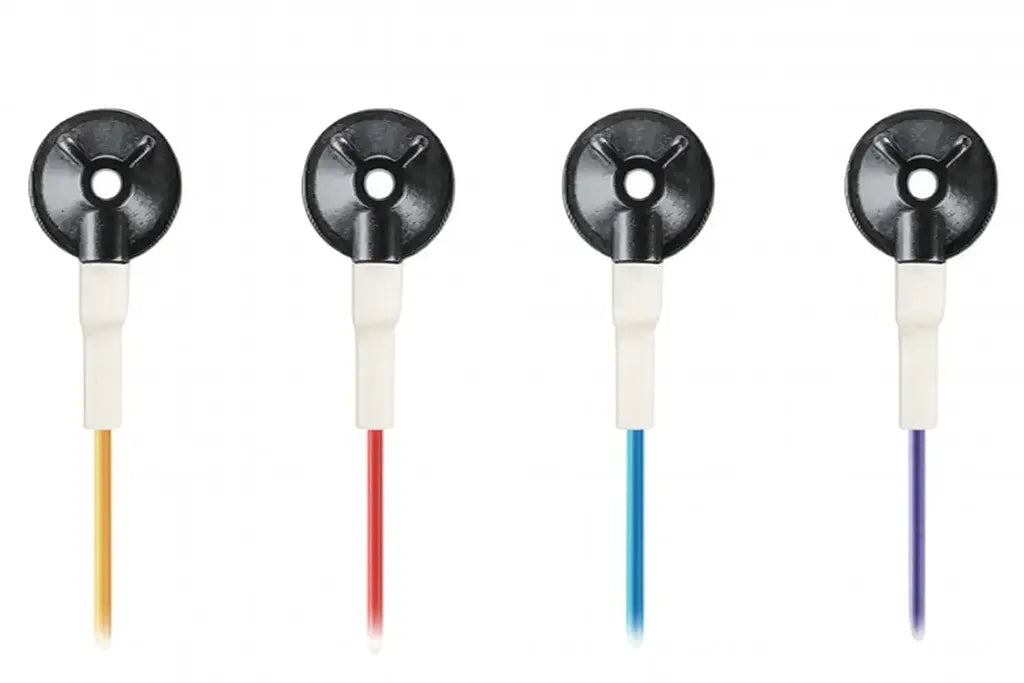
CNSAC disposable EEG cup electrodes were developed for standardized EEG signal acquisition in clinical and scientific applications.
Technical Specifications
- Ag/AgCl sensor for stable signal detection
- 10 mm cup diameter for a defined contact area
- 1.6 mm gel opening for controlled application of the contact medium
- Flexible connection cables for convenient use
- Color-coded cables for efficient channel assignment
- 1.5-mm DIN connectors for compatible EEG systems
- Single-use to ensure a standardized baseline condition for each examination
Various cable lengths for different workflows
CNSAC offers disposable EEG cup electrodes in various cable lengths:
|
Model |
cable length |
|
75 cm |
|
|
100 cm |
|
|
150 cm |
The electrodes are supplied in sets of 25.
This allows facilities to select the cable length based on their specific examination setup and the EEG configuration being used.
For which applications are disposable EEG cup electrodes useful?
Various factors come into play when selecting an EEG electrode system:
- desired standardization,
- Volume of investigations,
- Workflow efficiency,
- Hygiene requirements,
- Duration of the examination and
- Handling Requirements.
Disposable EEG cup electrodes can be a practical solution, particularly in settings where many examinations are performed and a standardized baseline condition is desired for each measurement.
This includes, for example: sleep diagnostics · routine EEG · neurological diagnostics · long-term monitoring · clinical and scientific applications
Tips for an Efficient EEG Workflow
Even with standardized disposable electrodes, careful preparation remains crucial for a good EEG recording.
To ensure a reliable workflow, we particularly recommend the following:
- Preparing the skin:
The skin should be prepared in accordance with the prescribed examination protocol. - Apply the contact medium correctly:
The conductive medium should be used in accordance with the application and the specifications of the respective product. - Check the electrode position:
Correct and stable positioning ensures reliable contact between the electrode and the skin. - Minimize cable movement:
Unnecessary movement of the connecting cables should be avoided to reduce mechanically induced interference. - Choose the Right Cable Length
Choosing the right cable length can help keep your setup organized and avoid unnecessary cable routing.
Conclusion
Good EEG data starts at the electrode-skin interface.
Since EEG signals are in the microvolt range, stable contact conditions and electrode performance that is as constant as possible are key components of a reliable measurement process.
CNSAC disposable EEG cup electrodes combine proven Ag/AgCl technology with a standardized single-use design.
- Consistent signal acquisition
- standardized electrode conditions
- Efficient Multichannel EEG Examinations
- Simplified hygiene procedures
- Support for Modern Clinical Requirements
CNSAC – Standardized Solutions for Modern Neurodiagnostics